

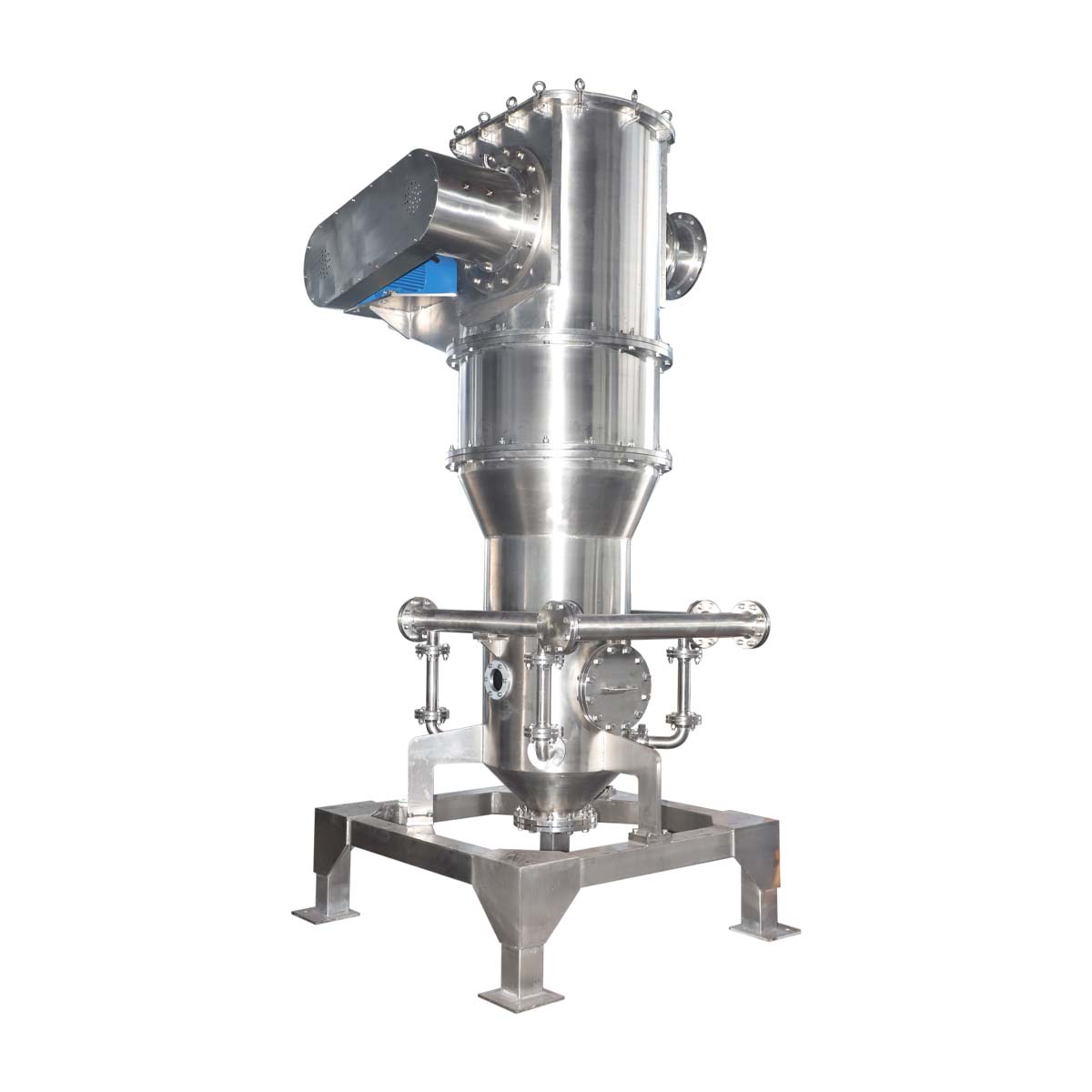
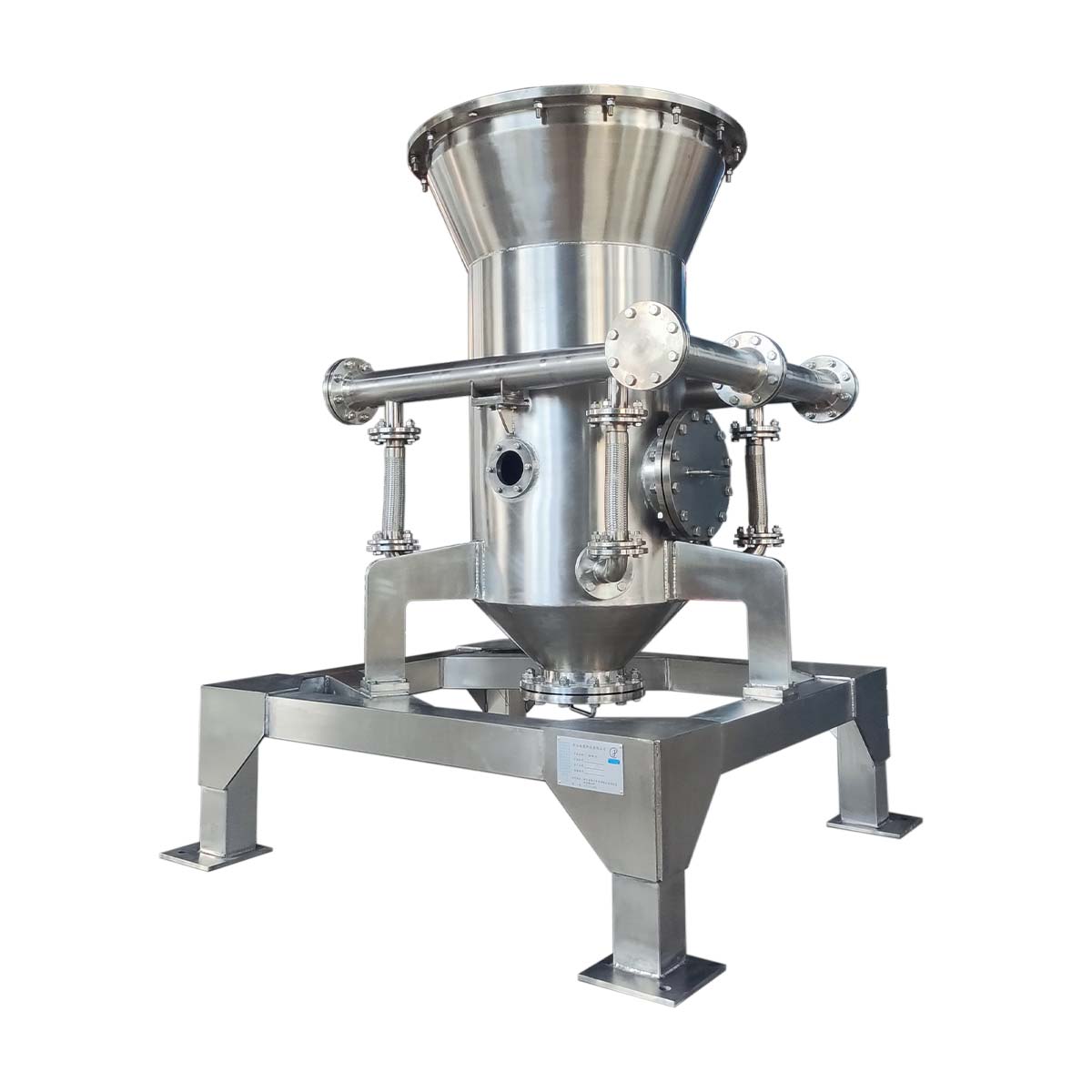


Fluidized Bed Opposed Jet Mill
How It Works
Spray-dried silica powder is fed into the grinding chamber through a screw feeder. Multiple groups of horizontally opposed nozzles eject high-pressure compressed air at supersonic speed, forming an upward fluidized bed field inside the chamber. Silica particles are accelerated by the airflow and violently collide with each other in the central jet intersection zone, achieving ultrafine de-agglomeration purely through particle-to-particle impact without any grinding medium contact, minimizing metal contamination. The airflow carries processed particles upward to the high-precision turbine classifier at the top. Qualified fine silica powder passes through the classifier blades and is collected by the cyclone separator and bag dust collector in sequence. Oversized coarse particles are thrown outward by centrifugal force, fall back to the fluidized processing zone along the chamber wall, and continue to participate in collision dispersion, forming a continuous closed-circuit cycle. The system operates under negative pressure to prevent silica dust leakage and secondary agglomeration, preserving stable BET surface area and dispersibility.
Technical Parameters
| Model Series: JFJM | 60 | 140 | 200 | 315 | 400 | 500 |
|---|---|---|---|---|---|---|
| Particle size (μm) | 1~50 | 2~50 | 2~50 | 3~50 | 4~50 | 4~50 |
| Diameter (mm) | 60 | 140 | 200 | 315 | 400 | 260×3 |
| Power (kW) | 1.1 | 4 | 5.5 | 15 | 22 | 7.5×3 |
| Maximum speed (r/min) | 18000 | 9800 | 6500 | 4000 | 3250 | 5000 |
| Output (kg/h) | 2~20 | 20~250 | 40~600 | 100~1500 | 250~2200 | 200~3000 |
| Compressed air consumption (m³/min) | 3 | 10 | 20 | 40 | 60 | 80 |
| Compressed air pressure (MPa) | 0.7~1.0 | 0.7~1.0 | 0.7~1.0 | 0.7~1.0 | 0.7~1.0 | 0.7~1.0 |
| Total power (kW) | 30 | 90 | 150 | 280 | 380 | 500 |
